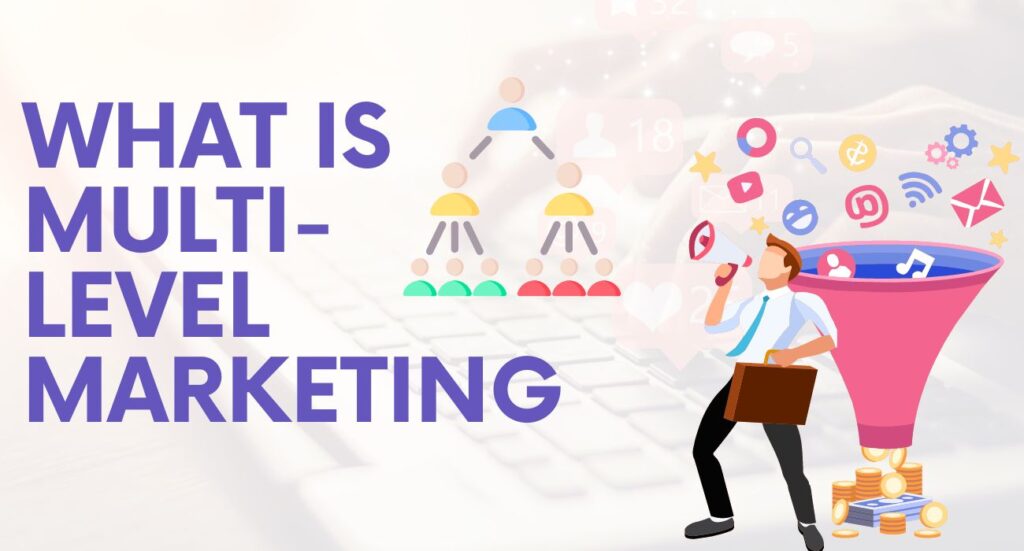


MLM stands for multi-level marketing. It’s a way of selling products through a network of independent sellers instead of stores. Each seller earns money on what they sell, plus a smaller cut of what the people they brought in sell. Those people are called their downline, and that’s where the “multi-level” part comes from.
You’ll also hear it called network marketing or direct selling. They’re close cousins, and most people use the terms interchangeably.
Online, MLM has a second meaning too, which is why so many people search for it. We’ll cover that further down.
What does MLM stand for?
MLM is short for multi-level marketing. Break the name down and it explains itself.
- Multi-level means you get paid on more than one level of sellers. Your own sales are level one, the people you recruited are level two, the people they recruited are level three, and so on.
- Marketing means the products are sold person to person, through friends, family, social media and home parties, rather than through ads and shop shelves.
What is an MLM?
An MLM is a company that sells its products this way. Instead of hiring a sales team, it signs up independent sellers, who usually get called distributors, consultants, ambassadors or business owners. Those sellers aren’t employees. They buy products at a discount, sell them at retail, and earn commissions on top.
Here’s a simple example. Say you join a skincare MLM.
- You sell a $50 moisturiser to a friend and keep a commission, often somewhere around 20 to 40 percent depending on the company.
- You invite your cousin to join as a seller. When she sells products, you earn a small percentage of her sales too.
- When she brings in her own sellers, you may earn a smaller percentage on their sales as well, depending on how deep the company’s pay plan goes.
That structure, where you earn from your own sales and from your team’s sales, is the whole idea of multi-level marketing.
Examples of MLM companies
Some of the biggest names in the world are MLMs. Amway is the largest, with $7.3 billion in revenue in 2025. Herbalife, Nu Skin, USANA and Scentsy are other well-known examples, and so are Mary Kay, doTERRA and Young Living, which keep their revenue private.
For the full list with real revenue figures, see our top 100 MLM companies list for 2026.
How do people make money in an MLM?
There are two ways to earn.
- Retail profit and commissions from selling products to customers.
- Team bonuses from the sales of people in your downline.
The honest truth is that most people in MLMs earn very little, and many lose money once they count what they spent on products, fees and events. A small number at the top earn a lot. If you’re thinking about joining one, look up the company’s income disclosure statement first. It shows what typical members really make, and it’s usually a lot less than the pitch.
If you still want to try one without a big upfront cost, our list of free MLM companies to join covers the ones that don’t charge to start.
Is an MLM a pyramid scheme?
Not automatically, but the line between them is the most important thing to understand.
A legitimate MLM makes its money selling real products to real customers. A pyramid scheme makes its money mainly from people signing up and buying in, and it collapses when the recruiting slows down. Pyramid schemes are illegal. MLMs are legal in the US as long as they stay on the right side of that line.
The quick test is to ask whether you could earn money without recruiting anyone. If the answer is no, be very careful. The FTC goes after companies that blur this line, as our breakdown of the Amway $225 million FTC settlement shows.
MLM meaning in slang and texting
If you saw MLM in a text, a social media bio or a TikTok comment, it probably didn’t mean multi-level marketing. In LGBTQ slang, MLM stands for “men loving men”, a term gay and bisexual men use to describe themselves or their relationships. You’ll often see it alongside WLW, which means “women loving women.”
Context usually makes it obvious which one someone means. If the conversation is about products, sales or a “business opportunity,” it’s multi-level marketing. If it’s about identity, dating or fandom, it’s the slang meaning.
The rest of this site is about the business meaning, so if that’s what you came for, keep reading.
MLM vs network marketing vs direct selling
- Direct selling is the broadest term. It covers any company that sells person to person instead of through stores.
- MLM is a type of direct selling where sellers also earn on the sales of people they recruit.
- Network marketing is mostly another name for MLM. Many companies prefer it because MLM has picked up a bad reputation.
Want to go deeper?
This page covers the meaning. For the full picture of how the model works, why most people don’t profit, and how to spot a good opportunity, read our honest guide on what multi-level marketing is. And if you’re thinking about building your own, see how to start an MLM company.
Frequently asked questions
What does MLM mean in business?
In business, MLM means multi-level marketing. It’s a sales model where independent sellers earn commissions on their own sales and on the sales of the people they recruit.
What does MLM stand for in text?
In texts and on social media, MLM usually stands for “men loving men,” an LGBTQ term. In business conversations it means multi-level marketing.
Is MLM legal?
Yes, MLM is legal in the US and most other countries, as long as sellers earn mainly from selling products to customers and not from recruiting. Companies that mostly pay for recruiting are pyramid schemes, which are illegal.
Is network marketing the same as MLM?
Mostly, yes. Network marketing is another name for multi-level marketing, and many companies use it because it sounds better.
Do people actually make money in MLMs?
Some do, but most don’t. Income disclosure statements from MLM companies regularly show that the typical seller earns little or nothing after expenses. Read one before you join anything.
Building an MLM business instead?
If you’re on the company side and want to launch your own MLM, we build multi-level marketing websites on WordPress, done for you, with your compensation plan set up and tested.